Bergwerksdorf Goldhausen

Description
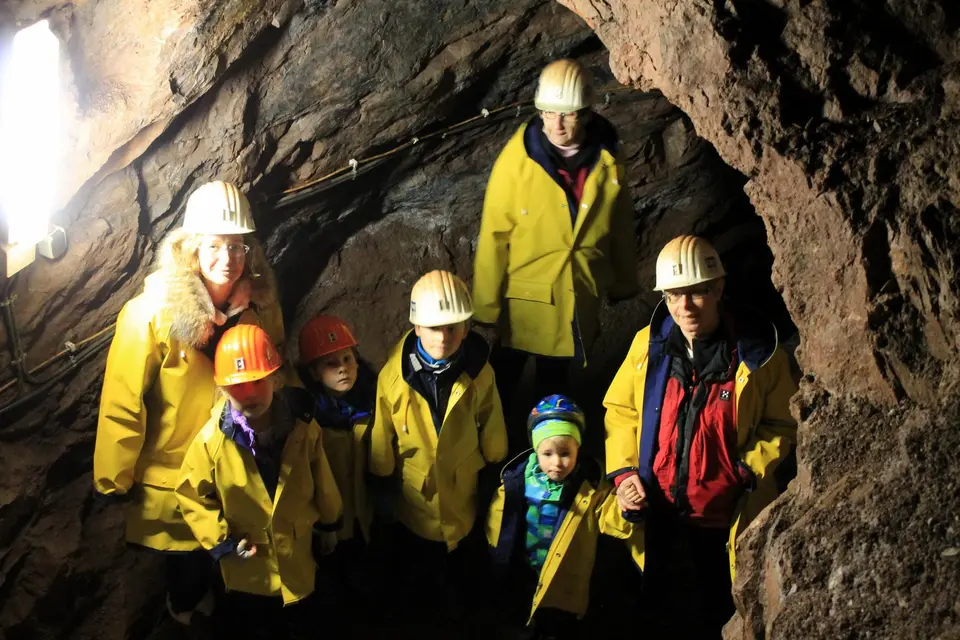
Gold was already being panned on the slopes of the Eisenberg in the 11th century. Underground mining began by the 14th century at the latest and reached its peak in the 15th and 16th centuries. Over the roughly 500 years of operation, miners drove more than 48 adits and 45 shafts, totaling about 20 km in length. The amount of gold extracted is estimated at about 1.2 tons. Because the deposit was exhausted, gold mining came to an end even before the Thirty Years' War. Since 2004, the visitor mine "Unterer Tiefer-Tal-Stollen" has offered insights into the Eisenberg, its geology, and its mining history.
Geology:
The geological history of the Eisenberg began about 360 million years ago in the Devonian period. Over roughly 40 million years, sediments settled in a sea basin only a few hundred meters deep. Gold was dissolved in low concentrations throughout the seawater. In the dark marine mud, which later became the black shales, pyrite (iron sulfide) formed, binding the gold. When the Rhenish Slate Mountains began to form in the Carboniferous period, the sediment layers were folded into the Medebach-Goldhausen Saddle, a geological fold structure between the Waldeck Syncline to the northwest and the Wittgenstein Syncline to the southeast. The core of the saddle contains Upper Devonian rocks, with Lower Carboniferous alum shales, lydites (black-gray, splintery siliceous slates), and siliceous limestones above them. The flanks of the saddle expose cleaved claystones and greywackes of the Lower Carboniferous. The primary gold deposit of the Eisenberg is mainly tied to tectonic fault zones that formed when the rock layers were folded during mountain building. Through these zones, hot waters were able to carry gold and other metals (lead, copper, selenium) from the black shales into neighboring fault zones. The most gold-rich tectonic faults ("Ruschelzonen", shear zones) occur in siliceous limestones and alum shales. They contain gold in the form of small flakes, needles, and crushed octahedral needles, with values up to 1,000 g per ton of rock. The north-south trending "Mittagsklüfte" and younger short thrusts directed to the southeast also carry gold. Even firmer siliceous limestone beds contain gold in fissures only millimeters thick, filled with calcite.
Apart from these relatively productive hard-rock deposits, gold is also found in younger unconsolidated sediments. There it occurs mainly as placer gold, meaning gold grains or flakes that were released by weathering, transported, and deposited again.
Mine tours:
From mid-April to the end of October. Details and registration at www.goldspur-eisenberg.de
The "Goldspur Eisenberg" gold theme trail, with two loop routes, is freely accessible at all times. An information brochure is available at the Korbach Information Center or, during mine tours, at the Zechenhaus Goldhausen.
Loyalty is coming to Bergwerksdorf Goldhausen
Soon you'll collect stamps and unlock rewards at the places you love — right inside Yayando. Want a heads-up when it goes live?
Details can change — please confirm important info with the venue.