Schröderstollen
Description
Excavation of the Schroederstollen was begun in 1922 by the Ilseder Hütte. Near Dörnten, the Ilseder Hütte operated the Georg-Friedrich iron ore mine.
The tunnel was to serve three purposes:
Shortening the existing ore transport route from the mine to the ore loading point at the Hannoversche Treue mine in Salzgitter-Calbecht, providing a natural outflow for mine water at the tunnel level of 170 m above sea level, and investigating the ore deposits around the Ilseder Hütte's mine fields. From 1924, the narrow-gauge railway line belonging to the tunnel was built through the forests of the Liebenburg state forest, between the western areas of Straute, Südholz, and Hasenspring and the eastern areas of Lewerberg and Kassebusch. On March 10, 1925, the Schroederstollen broke through to the 60-meter level of the Georg-Friedrich mine. It was named after the state geologist of the time, Dr. Henry Schroeder. The tunnel was 2,206 meters long in total, with a width of 3.4 meters and a height of 2.5 meters. The gradient toward the portal was 1 in 1,000.
Tracks with a gauge of 780 mm were laid on the tunnel floor. Railway construction was completed in December 1925. 100 meters beyond the tunnel portal was a transfer yard with five tracks for shunting and several small operating buildings. The tunnel locomotives ran to this point and then handed over the wagons to the line locomotives. Inside the tunnel, the old locomotives from the former railway to Dörnten station were used, but their cabs had to be lowered. On the 14.7-kilometer surface route, Siemens overhead-line locomotives with an operating weight of 40 tons came into service from 1934; before that, steam locomotives were used.
These hauled so-called Berliners, each loaded with four tons of iron ore, past Liebenburg and through Salzgitter-Bad. At Calbecht, the ore was transferred into railway wagons (self-discharging) with a capacity of 65 tons. The old transfer station in Dörnten had already been abandoned in 1929, and the unneeded line to it had been dismantled.
In 1938, a 720-meter exploration drift was driven from the Schroederstollen to the boundary survey line of the neighboring Morgenstern mine, owned by the Vereinigte Stahlwerke, in order to investigate the field sections located there.
After the Reichswerke Hermann Göring was founded, the Ilseder Hütte's land in the area of the Hannoversche Treue mine was expropriated. As a result, a new ore transfer station had to be built at Salzgitter-Voßpaß in 1940.
As early as 1965, the outdated and repair-dependent ore railway was to be replaced by truck transport. Because of the poor economic situation of German iron ore mining, the investments for this were postponed.
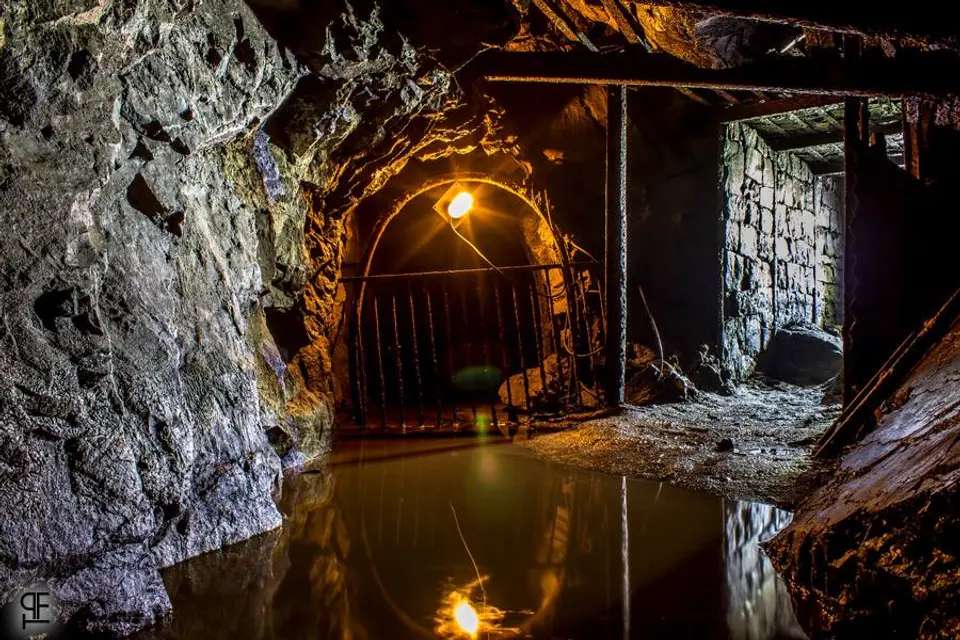
After the Georg-Friedrich mine was shut down in 1968, the Schroederstollen became redundant. The tunnel was especially interesting to geologists, because it had once fully exposed the entire Salzgitter ridge and its rock layers from north to south. Accordingly, Heinz Kolbe, the company geologist of Salzgitter Erzbergbau and a local history researcher, advocated keeping the tunnel open. The Ilseder Hütte rejected this because of the high costs. In 1970, a dam was built inside the tunnel to supply process water for a rendering plant that had taken over the mine's buildings in Dörnten. The portal was then backfilled and the tracks were dismantled.
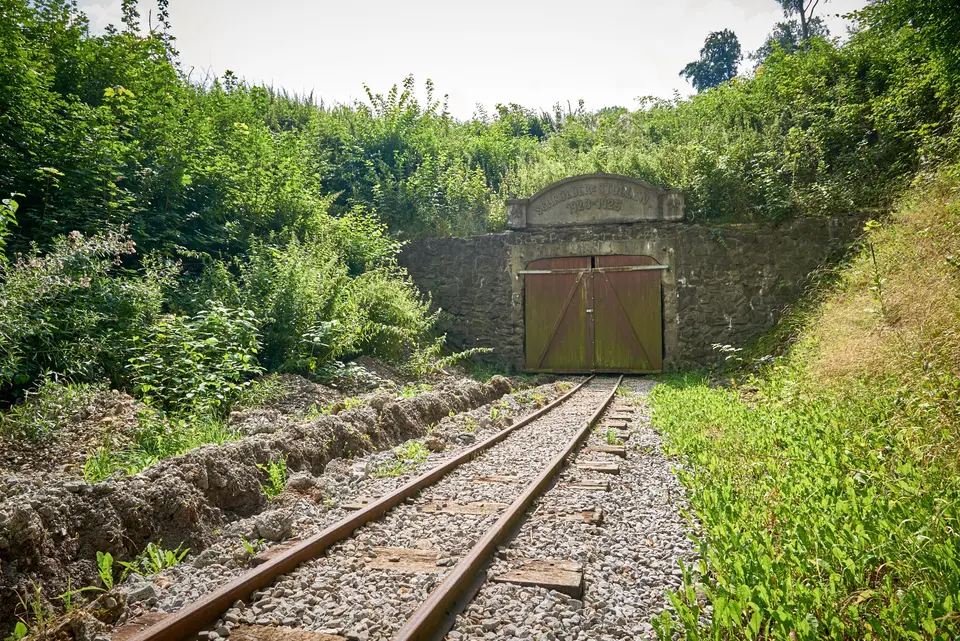
Since 2006, the original portal has been restored and the first tunnel meters have been cleared. In front of the portal, part of the narrow-gauge railway is being rebuilt for demonstration purposes, but for technical reasons in a changed gauge of 600 mm.
The former railway route is today largely used as a hiking trail (Hiking Trail No. 5 Liebenburg–Salzgitter-Bad). The buildings of the ore transfer station at Voßpaß fell into disrepair after it was shut down and were demolished in 2013/14.
Source: Wikipedia
Loyalty is coming to Schröderstollen
Soon you'll collect stamps and unlock rewards at the places you love — right inside Yayando. Want a heads-up when it goes live?
Details can change — please confirm important info with the venue.