Kloster Lüne
Description
Step into Kloster Lüne on the edge of Lüneburg and enter a different world. Far from the bustle of the city, you’ll find a women’s convent that is almost 850 years old. Its remarkable history, picturesque gardens, and valuable art treasures captivate visitors. This article takes you on a journey of discovery through its historic walls and offers insight into what makes this unique place special.
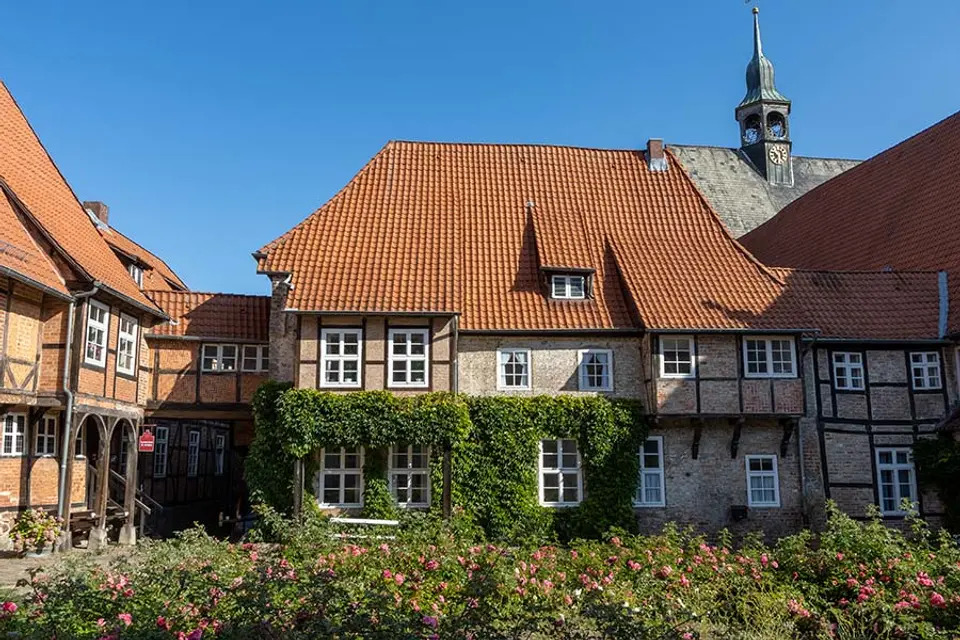
A Fairy-Tale Welcome: The Inner Courtyard of Kloster Lüne You really do feel as though you’ve stepped into another world when you enter Kloster Lüne. Through an unassuming entrance you pass into a corridor and suddenly find yourself in a courtyard that could have come straight out of a fairy tale. Blooming roses and lush ivy create an appealing contrast with the red brick and traditional half-timbering of the convent buildings.
The Long History of Kloster Lüne: More Than 850 Years of Living Tradition Kloster Lüne in Lüneburg is a very impressive women’s convent that has been inhabited almost continuously since it was founded in 1172. The Bishop of Verden granted permission for the foundation to pious women. From 1272 the community lived according to the Rule of Saint Benedict. Over the centuries the convent was expanded several times. Because it remained undamaged from 1372 onward, it still presents its historic fabric today.
After a devastating fire in 1372, Kloster Lüne was quickly rebuilt. By 1420 the convent church and the cloister quadrangle were gleaming in the characteristic brick Gothic style that survives to this day. The convent had considerable resources, not least from its significant share in the Lüneburg saltworks.
The Reformation presented the convent with a challenge. For more than 50 years the nuns refused to accept the new faith of the territorial ruler, Duke Ernst “the Confessor.” Perhaps the duke’s tight financial situation played a role, as he may have been interested in the valuable convent estates. Only in the mid-17th century did a deeply rooted Protestant piety take hold in the convent.
Well into the 20th century, Kloster Lüne served as a respectable institution for unmarried daughters of the nobility and the knightly class. Up to 60 nuns lived here in Lüneburg. Today nine independent women live in the convent, keeping its Protestant monastic tradition alive.
Architectural Treasures and Works of Art: A Tour of the Convent A tour or guided walk through Kloster Lüne surrounds visitors with a special atmosphere that makes it possible to immerse themselves in the eventful history of this place.
The Gothic Well: A Monument of Its Time When you enter the convent, your gaze first falls on the Gothic well, whose water has been flowing unceasingly into the stone basin for over six centuries.
The Cloister: Colored Windows and Stillness The cloister that adjoins it forms the traditional heart of every convent. Here the numerous 15th-century stained-glass windows are especially admirable, their colored light creating a devout atmosphere.
The Chapter House: Portraits of Abbesses and a Royal Visit The chapter house served the nuns as their central meeting place. Here hangs the impressive gallery of abbess portraits, which has been complete from 1580 to the present. Also on display are the magnificent abbess’s throne and the coronation portrait of George II, King of England and Elector of Hanover, who was received in this room in 1729. To house him in a manner befitting his rank, the pink Baroque house was built in the middle of the convent.
Summer and Winter Refectories: History in Painted Beams and Cool Walls The summer refectory, also called the Sommerremter, impresses with its strikingly painted beams. These were fully restored in the 1980s and reflect the unusual color scheme of 1482. Today this room is also used for wedding ceremonies. Right next door is the winter refectory, the Winterremter, a dark and cool room that inspires awe. On the left side you can see the painted pantries of the nuns, whose painting begins only above the usual storage height and offers a glimpse into the quiet life of the nuns during meals.
Sarggang and Uhlenflucht: A Look into the Nuns’ Chambers The unusual names “Sarggang” and “Uhlenflucht” refer to long corridors on the upper floor that lead to the nuns’ chambers. In the rather dark and mysterious Uhlenflucht, some of these chambers can be visited. They range from spartan to elaborately furnished, depending on the rank and financial means of their former occupants. A few chambers even had Delft tiles, which arrived in Lüneburg on the salt ships.
The Nuns’ Choir: Where the Bells Rang The nuns’ choir is also open to visitors. The ropes the nuns once used to ring the bells still hang from the ceiling. The numerous ornately carved choir stalls bear witness to the convent’s former size. The impressive Vespers singing also takes place here.
The Convent Church: High Altar and Impressive Organ The convent church houses important art treasures. The carved high altar from 1524 and the enormous organ from 1645 immediately draw every eye and are among the finest of their kind in Niedersachsen.
The Teppichmuseum: Textile Works of Art from the Centuries The convent in Lüneburg is also known for its significant textile art. In the Teppichmuseum you can admire a unique collection of sacred textiles that were made in the convent over seven centuries and have survived. Highlights include embroidered altar and Lenten cloths from the 13th and 14th centuries, large pictorial tapestries and bench cloths from around 1500, and procession banners from 1410. A new building was erected in 1995 for this valuable exhibition.
“Die Netzwerke der Nonnen”: A Look into the Past Through Historical Letters A special find is the 1800 letters from the Reformation era, the 15th and 16th centuries, which lay hidden in a manuscript chest at Kloster Lüne. Under the project name “Die Netzwerke der Nonnen,” these letters have been analyzed for several years by researchers, and they reveal surprising insights into the nuns’ lives and their connections to Lüneburg patrician families.
A Place of Encounter and Reflection: Kloster Lüne Today The convent is not only a historic monument but also a living place. Guided tours of the complex, which remains almost entirely intact, take place from April to October. A special experience is the Vespers singing in the nuns’ choir. In addition to the regular tours, concerts, readings, and other cultural events also take place here. The living Christian monastic tradition combines with a modern sense of togetherness.
The Café at the Convent: A Break in Historic Surroundings The “Café im Kloster” invites you to linger in its appealing atmosphere and offers a welcome opportunity to let the impressions of the convent settle over a cup of coffee or a small snack. When the weather is nice, the coffee garden by the orchard meadow beckons as well.
Frequently Asked Questions (FAQ) What is special about Kloster Lüne?
Kloster Lüne impresses with its history of almost 850 years, its largely preserved medieval fabric, and the unique combination of convent life and museum treasures. The quiet, contemplative atmosphere in the middle of the city is also remarkable.
What art treasures can be seen at Kloster Lüne?
Among the most significant works are the Gothic well, the colored stained-glass windows in the cloister, the portraits of the abbesses in the chapter house, the carved high altar and historic organ in the convent church, and the valuable textiles in the Teppichmuseum.
Can you take part in guided tours at Kloster Lüne?
Yes, during the season from April to October, guided tours through the convent are offered regularly, providing a comprehensive look at its history and sights.
Is there accommodation at Kloster Lüne?
Kloster Lüne is today inhabited by a Protestant community and serves primarily as a residence and a place for preserving tradition. There are no regular overnight facilities for visitors. In the surrounding area, however, you will find various hotels and guesthouses.
Where can you park near the convent?
Parking spaces are available directly along the roadside in front of the convent and on Lüner Weg.
Find out more about the fascinating history and plan your visit to experience this unique place for yourself!
Loyalty is coming to Kloster Lüne
Soon you'll collect stamps and unlock rewards at the places you love — right inside Yayando. Want a heads-up when it goes live?
Details can change — please confirm important info with the venue.